
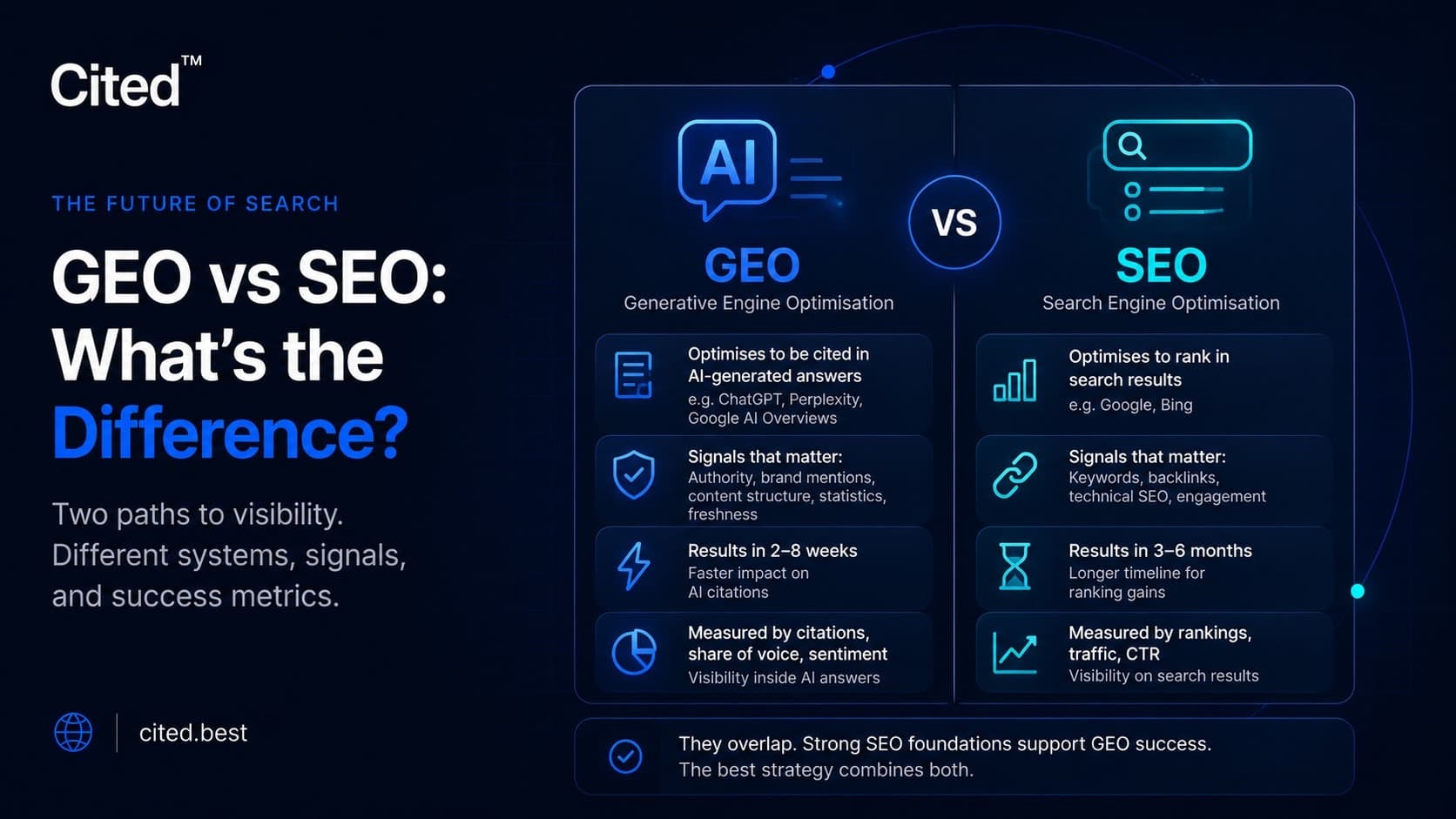
Generative Engine Optimisation (GEO) is the practice of structuring web content so that AI tools like ChatGPT, Perplexity, and Google Gemini choose it as a source when generating answers. Unlike SEO, which targets a position in search results, GEO targets citation inside the AI's answer itself. The global GEO services market was valued at USD 1.01 billion in 2025 and is projected to reach USD 17.02 billion by 2034, a CAGR of 45.5% (Intel Market Research). Content containing named statistics is cited by AI up to 37% more often than content without them (Princeton University). Core principles: open with a definition, include sourced data, use question-based headings, write in self-contained paragraphs, and build interconnected article clusters.
SEO has been the backbone of digital marketing for two decades — but Generative Engine Optimisation is changing what it means to be visible online. This article compares GEO and SEO side by side: how they work, how success is measured, and why smart marketers in 2026 need both.
What is the Difference Between GEO and SEO?
Search Engine Optimisation (SEO) is the practice of improving a webpage's chances of appearing high in a traditional search results list, primarily on Google. Generative Engine Optimisation (GEO) is the practice of improving a webpage's chances of being cited inside an AI-generated answer, on platforms like ChatGPT, Perplexity, and Google's AI Overviews. Both disciplines aim to make content more discoverable, but they target different systems and reward different types of content.
The key difference in outcome is also different: SEO success is measured in rankings and clicks from a list. GEO success is measured in whether your content is the source an AI tool draws from when answering a user's question. The two are complementary — but they are not the same thing, and treating them as interchangeable is a strategic mistake.
Why Is the Balance Between SEO and GEO Shifting?
The balance is shifting because user behaviour is shifting. Millions of users now begin their information searches in ChatGPT, Perplexity, or Google AI Overviews rather than in a traditional search box. For those queries, a page's Google ranking is irrelevant if its content is not also cited in the AI's answer.
The data on this shift is stark. According to a 2025 Gartner forecast, organic search traffic to commercial websites will decline by 25% by the end of 2026 as AI answer engines absorb more queries. At the same time, AI-referred sessions grew by 527% in the first five months of 2025 alone (Digital Agency Network). Traditional organic search still drives 48.5% of all website traffic globally, while AI platforms currently account for approximately 0.15% — but the direction and rate of change are unmistakeable.
What Does SEO Optimise For?
Traditional SEO optimises for the signals that determine how Google ranks pages in its search results. These signals include keyword relevance (using the terms your audience searches for, in the right places on your page), backlink authority (earning links from reputable external sites that signal credibility), technical performance (page speed, mobile design, site architecture), and user engagement metrics such as time on page and click-through rate.
SEO results take time. Improvements to a page typically take three to six months to translate into ranking gains, and the competition for top positions on high-value keywords is intense. SEO rewards long-term, consistent investment rather than quick wins.
What Does GEO Optimise For?
GEO optimises for the signals that make AI tools trust and extract from your content when generating answers. These are distinct from traditional SEO signals and require a different approach to content creation.
Domain authority and brand credibility remain relevant: sites with more than 32,000 referring domains are 3.5 times more likely to be cited by ChatGPT than lower-authority domains (AI Boost, 2026). Content structure matters significantly — clear headings, direct definitions, and short self-contained paragraphs all increase extraction likelihood. Evidence quality is perhaps the most differentiating factor: research from Princeton University found that including specific, sourced statistics in content increases AI citation probability by 37%. And content freshness is critical: pages updated within the past 12 months are twice as likely to be cited as older content (AirOps, 2025).
Branded web mentions are also a disproportionately important signal for GEO — they correlate three times more strongly with AI visibility than backlinks alone. Appearing in Reddit discussions, Quora answers, LinkedIn articles, and third-party reviews builds the kind of distributed authority that AI citation systems use to validate a source.
How is Success Measured Differently in GEO vs SEO?
SEO success is measured through familiar metrics: keyword rankings, organic traffic volume, and click-through rates. These are tracked with mature tooling and understood by most marketing teams.
GEO success is measured differently. The headline metric is citation rate — how often your content is referenced in AI-generated answers for your target queries. Supporting metrics include share of voice (your citation rate relative to competitors), sentiment (whether your brand is described positively, neutrally, or negatively when cited), and which specific URLs are being referenced. The commercial case for investing in GEO is supported by the conversion data: Semrush research shows AI-referred visitors convert at 4.4 times the rate of standard organic visitors. Microsoft Clarity data confirms they subscribe at 2.4 times and sign up at 10 times the rate of traditional search visitors.
Where Do GEO and SEO Overlap?
The overlap between GEO and SEO is substantial, which is good news for anyone who has already invested in SEO. A well-structured, authoritative article that performs well in Google is also well-positioned to earn AI citations. The core attributes of good SEO — clear writing, logical structure, external credibility, and current content — are the same attributes GEO rewards.
Topic cluster strategy, which has dominated advanced SEO for several years, aligns especially well with GEO requirements. Sites with 20 or more interconnected articles on a subject see 3.2x higher AI citation rates than isolated standalone pages (Nestcontent, 2026). Building comprehensive coverage of a topic area is rewarded by both disciplines.
Should You Prioritise GEO or SEO in 2026?
You should prioritise both, simultaneously, with an allocation that reflects the current traffic reality and your investment horizon. Traditional organic search still drives 48.5% of all website traffic globally — abandoning SEO to focus exclusively on GEO would be a significant error. The audiences, the volumes, and the commercial returns from SEO remain substantial.
At the same time, the rate of change clearly favours early GEO investment. GEO results typically appear within two to eight weeks of implementing changes, compared to three to six months for SEO improvements. The competitive landscape for AI visibility is less saturated than for traditional search — acting now, before your category is dominated by competitors who recognised the opportunity earlier, is the strategically sound position.
The practical approach is to apply GEO principles to your best-performing SEO content first. Take your highest-traffic articles, ensure they open with a clear definition, include at least five named statistics with sources, and use question-based headings throughout. Then monitor whether those pages begin appearing in AI-generated answers. The marginal cost of this improvement is low; the potential return — in a channel where visitors convert at 4.4 times the organic rate — is high.
Ready for your AI score?
See how visible your site is to ChatGPT, Perplexity & Gemini.
Start FREE auditResults in minutes · 100% free