
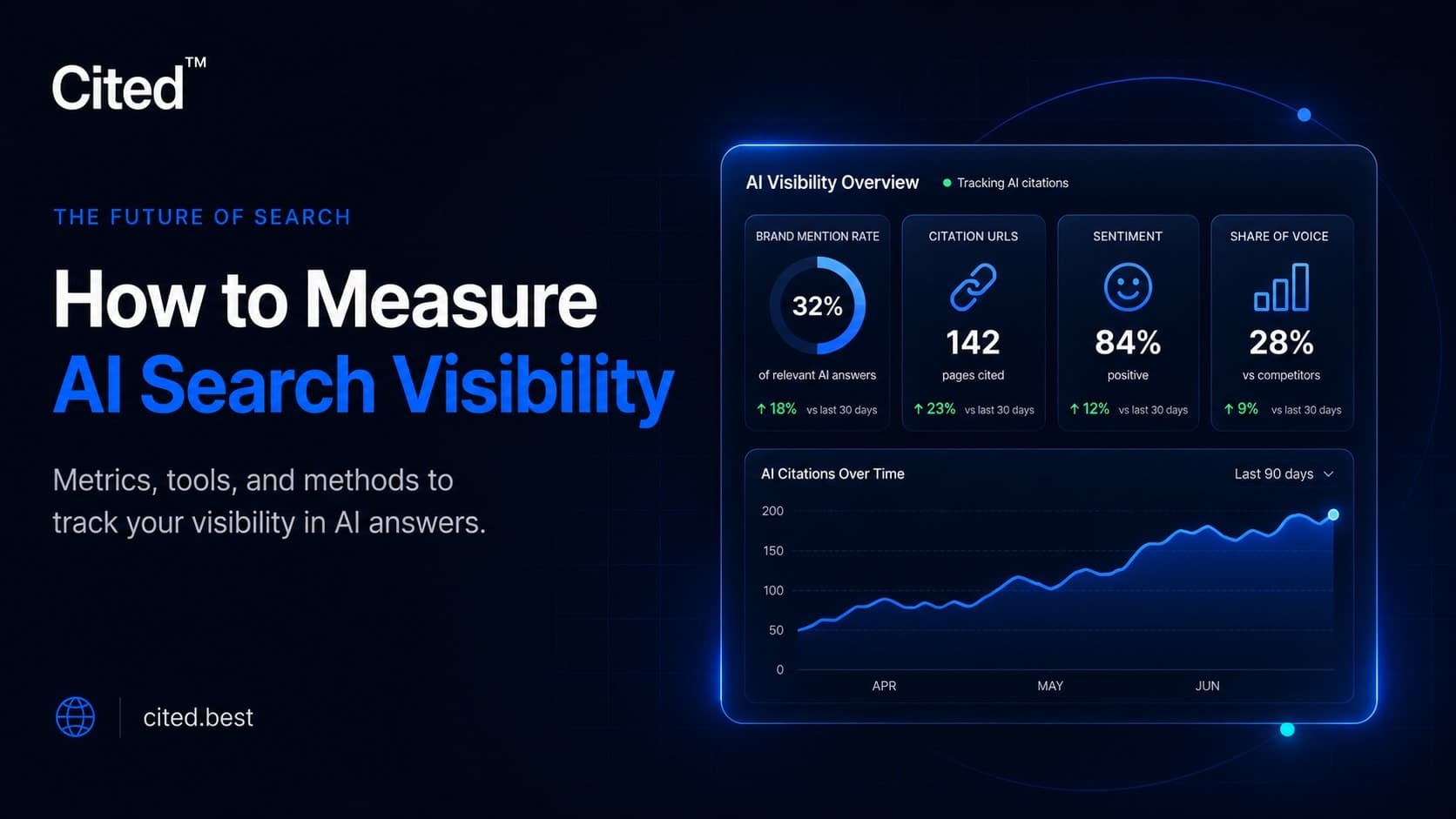
AI search visibility measures how often and how prominently your brand or content appears as a source in AI-generated answers across ChatGPT, Perplexity, Google AI Overviews, and other platforms. The four core metrics are: brand mention rate (your share of voice in AI answers), citation URL inclusion (which pages are referenced), sentiment when cited, and competitive share of voice. Over 60% of Google searches now feature AI-generated answers (AirOps, 2025), and AI engines drove 1.13 billion referral visits in June 2025. AI-referred visitors convert at 4.4 times the rate of standard organic visitors (Semrush). Pages updated within the past 12 months are twice as likely to earn citations. Tools including Cited.best, Profound, Omnia, and Nightwatch provide automated tracking.
Google rankings no longer tell the full story. As AI tools like ChatGPT and Perplexity answer more searches directly, a new set of metrics is needed. This article explains what AI search visibility is, how to track it, and which tools — including Cited.best — can help you stay on top of it.
What is AI Search Visibility?
AI search visibility is a measure of how often and how prominently your brand, content, or products appear as sources within AI-generated answers across platforms like ChatGPT, Perplexity, Google AI Overviews, and Microsoft Copilot. Unlike traditional search rankings — where position one, two, and three are clearly defined — AI visibility is about whether you are cited at all, how frequently, and what is said about you when you are. Measuring it requires a different set of metrics and a different mindset from the tools most marketers are used to.
Why Are Traditional SEO Metrics No Longer Enough?
Traditional SEO metrics — keyword rankings, organic traffic, and click-through rates — remain valuable, but they no longer capture the full picture of how content performs in search. AI-generated answers are intercepting a growing share of queries before users ever reach a results page, and those visits are not always reflected in standard analytics.
The scale of this shift makes new measurement approaches urgent. Research from AirOps found that over 60% of Google searches now feature AI-generated answers, up from near zero just three years ago. AI engines drove 1.13 billion referral visits in June 2025 alone. According to market projections, $750 billion in US revenue will flow through AI search by 2028 (AirOps, 2025). Brands that measure only traditional search performance are flying blind across a channel that is already material and growing fast.
The conversion case makes this even more compelling. Research from Semrush found that AI-referred visitors convert at 4.4 times the rate of standard organic visitors. Microsoft Clarity data confirms that AI-referred users subscribe at 2.4 times and sign up at 10 times the rate of traditional search visitors. A smaller, more qualified stream of AI-generated traffic can be commercially more valuable than a larger volume of conventional organic visits.
Which Metrics Matter Most for AI Visibility?
AI search visibility breaks down into four core metrics, each measuring a different dimension of how your brand performs in AI-generated answers.
Brand Mention Rate:The percentage of relevant AI-generated answers that include a mention of your brand, product, or website. This is your headline metric — the AI equivalent of share of voice. Calculate it by running a defined set of target queries across AI platforms and recording how often you appear.
Citation URL Inclusion:Which specific pages on your site are being linked or referenced? This tells you which content is earning citations and helps identify what structural or substantive qualities those pages share — qualities you can replicate across other content.
Sentiment When Cited:When your brand appears in an AI answer, is the context positive, neutral, or negative? An AI that cites you as a cautionary example is very different from one that cites you as the authoritative source. Sentiment adds crucial nuance to raw citation counts.
Competitive Share of Voice:How often are you cited compared to your main competitors in response to the same queries? This contextualises your absolute citation rate and reveals whether you are winning or losing the AI visibility battle in your category.
What Tools Are Available for Tracking AI Search Visibility?
The AI visibility tooling market grew rapidly in 2025, with more than 22 dedicated platforms emerging to address this challenge (Omnia, 2025). The options range from enterprise platforms to accessible specialist tools.
Cited.bestis a dedicated AI search visibility tracker built specifically for this purpose. It provides a free full audit covering six visibility dimensions — Citability, Authority, Content, Technical, Schema, and Platforms — and monitors performance across ChatGPT, Perplexity, Gemini, Copilot, and Claude. Every audit is reviewed by a human AI technician, and results arrive in your inbox within five minutes.Start a free audit at cited.best.
Profound provides enterprise-grade tracking across ChatGPT, Perplexity, Gemini, and Copilot, with content generation and CMS publishing workflows built in. Pricing starts at $99/month. Nightwatch bridges traditional SEO and AI monitoring, connecting blue-link rankings with ChatGPT citations in a unified dashboard. Omnia and AthenaHQ both provide AI-specific citation tracking with competitive benchmarking, starting from $199/month and $270/month respectively.
How Do You Set a Baseline and Track Progress?
Measurement only becomes actionable when you track changes over time. Before implementing any GEO improvements, document your current AI visibility across a defined set of target queries — typically 20 to 30 questions your customers would ask an AI tool when researching your product or service category. This baseline gives you a comparison point for everything that follows.
Aim to re-run your measurement process every four to six weeks. Research suggests GEO improvements typically show measurable impact on AI citations within two to eight weeks — considerably faster than the three to six months traditionally required for SEO gains to appear. This means you can iterate and test more rapidly than in conventional SEO. Content freshness is also a continual factor: pages updated within the past 12 months are twice as likely to earn citations as older content (AirOps, 2025), making regular content refreshes a core part of ongoing AI visibility maintenance.
What Mistakes Should You Avoid When Measuring AI Visibility?
A few common errors reduce the reliability of AI visibility measurements and should be avoided.
- Running queries only once. AI platforms can return different sources for the same query across different sessions. Run each target query at least three times and use the average to get a representative result.
- Ignoring paraphrased mentions. AI tools often paraphrase or summarise content without a direct citation link. Manual monitoring needs to capture these unlabelled mentions alongside explicit source attributions.
- Measuring only branded queries. Whether you appear when someone searches your brand name measures awareness, not category authority. The more valuable signal is whether you appear for general category questions — the ones users ask before they know which brand they want.
- Treating all platforms the same. ChatGPT, Perplexity, and Google AI Overviews have distinct citation behaviours, different user bases, and different source selection patterns. Track each platform separately and look for patterns in where you perform strongly versus where gaps exist.
How Does AI Visibility Connect to Business Outcomes?
The ultimate purpose of measuring AI visibility is to connect it to commercially meaningful outcomes: leads, sign-ups, sales, and revenue. As tooling matures, it is becoming possible to trace the full path from AI citation to website visit to conversion using standard analytics platforms.
The most practical current approach is to identify AI-sourced traffic in your analytics (visible under traffic sources or referral data from AI platforms), track its conversion rate against other channels, and use that comparison to build a business case for AI visibility investment. Given that Semrush data shows AI-referred visitors converting at 4.4 times the rate of organic visitors, even a modest volume of AI-generated traffic can have a disproportionate commercial impact.
Ready for your AI score?
See how visible your site is to ChatGPT, Perplexity & Gemini.
Start FREE auditResults in minutes · 100% free